




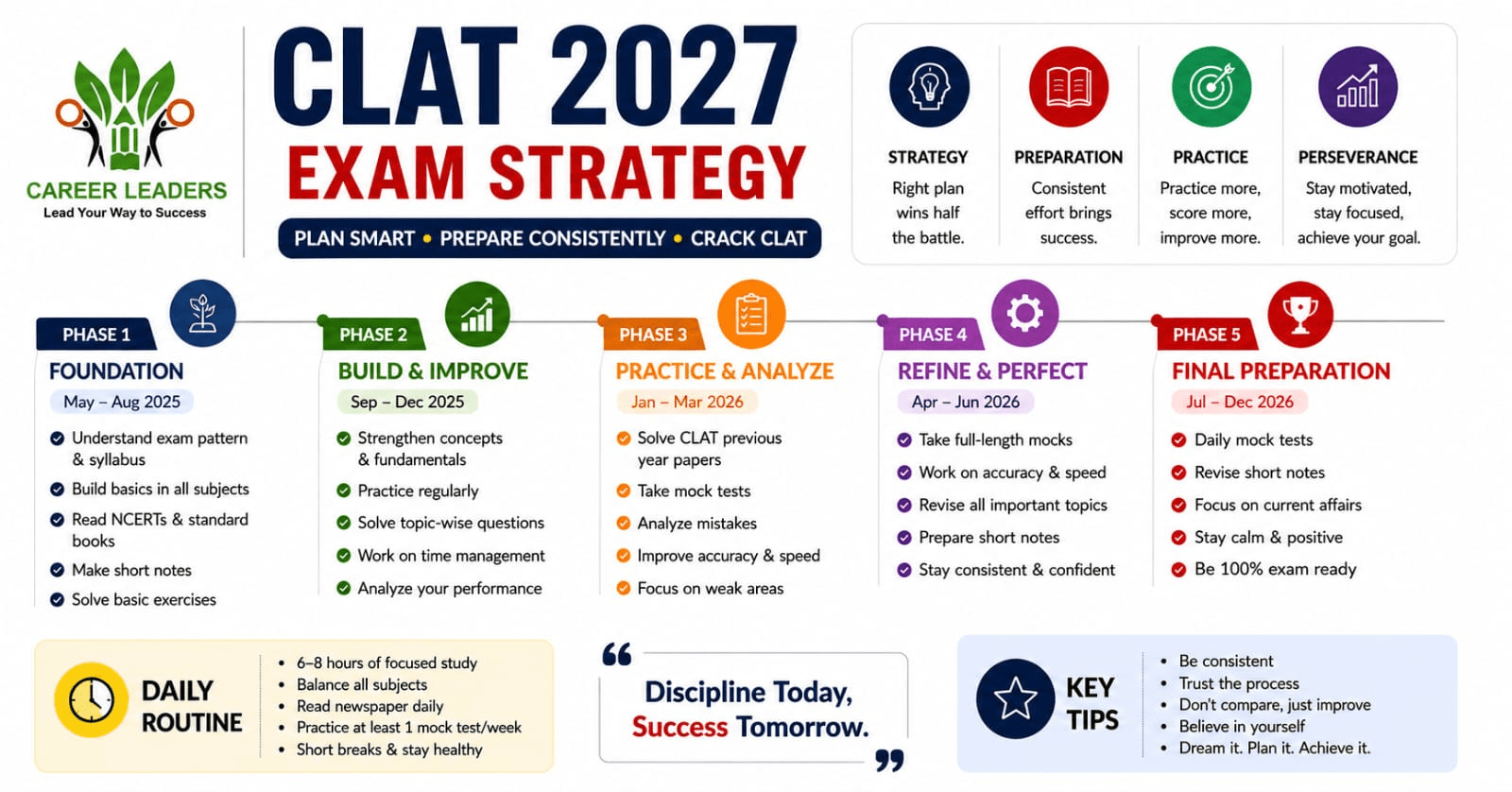
CLAT Preparation Tips for Beginners: A Subject-Wise Study Plan
Preparing for a competitive law entrance exam can feel challenging at first. However, following the right CLAT preparation tips for beginners can make your preparation easier and more organized. With a clear study plan, regular practice, and proper guidance, you can build strong reading, reasoning, and problem-solving skills. Career Leaders helps students explore entrance exam preparation options and plan their academic journey. Located at D-151-A, 2nd Floor, Opposite Laxmi Nagar Metro Gate No. 5, Laxmi Nagar, New Delhi, Delhi – 110092, Career Leaders provides students with access to entrance exam guidance. For course inquiries, call +91 95827-15775. Start by understanding the CLAT exam pattern, identifying your strengths, and following a subject-wise study plan. Most importantly, stay consistent and track your progress throughout your preparation.

Why Do Beginners Need a CLAT Preparation Strategy?
A good CLAT preparation strategy helps you study with a clear goal. Instead of studying every topic without a plan, you can divide your time between different subjects. As a result, your preparation becomes more organized and manageable.
CLAT tests skills such as reading comprehension, logical reasoning, legal reasoning, general knowledge, and quantitative techniques. Therefore, students need more than memorization. They must also learn to understand passages, analyses information, and answer questions accurately.
Moreover, beginners should focus on building strong basics before attempting difficult questions. Regular revision is equally important because it helps you remember important concepts. With a practical routine, you can improve gradually without feeling overwhelmed.
How to Prepare for CLAT: Understand the Exam Pattern First
If you want to learn how to prepare for CLAT, start by understanding the exam structure. Check the latest official notification for the exam pattern, eligibility requirements, syllabus, and important dates.
The UG CLAT generally assesses five areas:
- English Language
- Current Affairs, including General Knowledge
- Legal Reasoning
- Logical Reasoning
- Quantitative Techniques
Each section requires a different approach. For example, English requires reading and comprehension skills, whereas quantitative techniques require numerical practice. Similarly, legal reasoning focuses on understanding legal principles and applying them to given situations.
Once you understand these sections, make a list of topics you already know and topics that need more attention. This step will help you create a realistic study plan.
CLAT Preparation for Beginners: Build Strong Fundamentals
Students who are new to law entrance preparation should avoid rushing through the syllabus. Instead, focus on understanding the basics of each subject. This approach can help you solve questions with greater confidence.
First, develop a daily reading habit. Read editorials, reliable news reports, and informative articles. In addition, practice vocabulary and learn to identify the main idea of a passage.
Next, solve basic reasoning questions and review your answers carefully. Whenever you make a mistake, try to understand why your answer was incorrect. This way, you can avoid repeating the same error.
Furthermore, revise important concepts every week. Short revision sessions can help you retain information for longer. As your understanding improves, gradually move towards timed practice sets and mock tests.
CLAT Subject-Wise Preparation: Tips for Every Section
A subject-wise approach makes your preparation more focused. Therefore, divide your study time according to the skills required in each section.
1. CLAT English Preparation Tips
The English section tests your ability to understand passages, identify key ideas, and interpret information. Therefore, regular reading should be an essential part of your routine.
Read articles from reliable newspapers and educational websites. After reading, summarize the main idea in your own words. This exercise can improve comprehension and help you recognize the writer’s point of view.
Additionally, practice questions on inference, tone, vocabulary, and passage analysis. However, do not focus only on memorizing difficult words. Learn how words are used in context because this skill can support better comprehension.
2. CLAT Logical Reasoning Preparation Tips
Logical reasoning requires careful thinking and a structured approach. You may need to identify arguments, recognize assumptions, and draw conclusions from a passage.
To improve these skills, practice a small set of reasoning questions every day. Start with basic questions and then increase the difficulty level. Moreover, read each question carefully before selecting an answer.
After completing a practice set, review both correct and incorrect responses. This process helps you understand the logic behind each answer. Over time, you can also learn to manage your time more effectively.
3. CLAT Legal Reasoning Preparation Tips
Legal reasoning is an important part of CLAT preparation. It tests your ability to understand legal principles and apply them to the facts provided in a question.
First, read the given principle carefully. Next, identify the relevant facts and check how the principle applies to the situation. Avoid choosing an answer based only on your personal opinion.
Furthermore, practice passage-based questions regularly. Focus on the connection between the principle and the facts rather than memorizing large amounts of legal information. Always check the latest official syllabus and guidance when planning your study material.
4. CLAT Current Affairs Preparation Tips
Current affairs preparation requires consistency. Studying everything just before the exam can become difficult. Therefore, develop a daily habit of reading reliable news sources and recording important information.
Focus on major national and international events, government initiatives, important reports, awards, and other relevant developments. However, select your study material carefully instead of collecting too many resources.
Maintain short notes for important topics. In addition, revise these notes every week and practice quizzes to test your knowledge. This routine can help you improve recall and identify areas that need more revision.
5. CLAT Quantitative Techniques Preparation Tips
The quantitative techniques section requires basic mathematical understanding and regular practice. Students should focus on interpreting numerical information, tables, graphs, and other data presented in questions.
Begin by revising fundamental concepts. Then, practice questions involving percentages, ratios, averages, and other topics included in the applicable syllabus.
Most importantly, understand the steps used to solve each question. Do not simply memories formulas without knowing how to apply them. As you improve, solve timed practice sets to develop speed and accuracy.
CLAT Study Plan for Beginners: Create a Daily Timetable
A realistic CLAT study plan for beginners can help you balance different subjects. However, your timetable should depend on your school schedule, current preparation level, and available study time.
Here is an example of a daily routine you can adjust according to your needs.
| Study activity | Suggested time |
|---|
| English reading and comprehension | 30 minutes |
| Logical reasoning practice | 30 minutes |
| Legal reasoning practice | 40 minutes |
| Current affairs and revision | 30 minutes |
| Quantitative techniques | 30 minutes |
| Reviewing mistakes | 20 minutes |
This sample timetable includes around three hours of study. If you have school or other commitments, start with shorter sessions and increase your study time gradually.
Additionally, keep one day each week for revision and practice tests. This will help you review your progress and make changes to your routine when necessary.
CLAT Preparation Tips for Class 11 and 12 Students
Students in Classes 11 and 12 need to balance school examinations with entrance exam preparation. Therefore, time management is essential.
First, create a weekly timetable that includes both school subjects and CLAT practice. During school examinations, give extra attention to board preparation while maintaining a manageable entrance exam routine.
Next, use small periods of free time for reading, vocabulary practice, and current affairs revision. These activities can support your preparation without taking up your entire day.
Moreover, avoid comparing your progress with other students. Everyone has different strengths and learning needs. Instead, set weekly goals and check whether you have achieved them.
If you are in Class 11, use the available time to build strong fundamentals. If you are in Class 12, focus on maintaining consistency, revising concepts, and practicing questions alongside your schoolwork.
CLAT Preparation at Home: How to Study Effectively
You can begin CLAT preparation at home with a clear routine and suitable study resources. However, self-study requires discipline and regular progress checks.
Choose a quiet study space and keep your books, notes, and practice materials organized. In addition, set a fixed time for studying each day to develop a consistent habit.
Use official exam information and reliable preparation resources. You can also use practice questions, reading materials, and mock tests to strengthen your understanding.
Whenever you find a difficult topic, revisit the basic concepts before moving ahead. If you continue to struggle, consider asking a teacher or mentor for help. Guidance can save time and help you understand mistakes more clearly.
Finally, reduce distractions during study sessions. Keep your phone away when it is not needed for learning, and take short breaks between focused sessions.
CLAT Mock Test Preparation: Improve Speed and Accuracy
Mock tests help you understand how well you can apply your knowledge under timed conditions. Therefore, include them in your preparation plan once you have covered the necessary basics.
Initially, focus on topic-wise tests. Later, attempt full-length mock tests under exam-like conditions. This approach helps you identify weak areas and practice managing time.
After each test, analyses your performance carefully. Review the questions you answered incorrectly, the questions you skipped, and the questions that took too long.
In addition, maintain a mistake notebook. Record the reason for each mistake and revisit similar questions during revision. As a result, you can focus on improving your actual weaknesses instead of repeatedly practicing only familiar topics.
Remember that a mock test score is a learning tool. Use it to measure progress rather than becoming discouraged by a low score.
Common Mistakes to Avoid During CLAT Preparation
Even motivated students can make mistakes during entrance exam preparation. Fortunately, a few simple changes can help you avoid them.
- Studying without a timetable: Set clear daily and weekly goals to maintain consistency.
- Ignoring weaker subjects: Divide your time according to your needs instead of focusing only on favorite topics.
- Using too many resources: Select reliable study materials and revise them properly.
- Skipping revision: Review important concepts and notes regularly.
- Avoiding mock tests: Use practice tests to understand your progress and time management.
- Ignoring mistakes: Analyses incorrect answers and learn from them.
- Memorizing without understanding: Focus on comprehension, reasoning, and practical application.
By correcting these habits early, you can make your preparation more organized and productive.
How Career Leaders Can Support Your CLAT Preparation
Preparing for CLAT becomes easier to organize when you have a clear study plan and access to suitable guidance. Career Leaders provides entrance exam preparation support for students exploring law and other higher education pathways.
With a structured approach, students can work on subject knowledge, practice questions, revise important concepts, and review their performance. Moreover, a planned routine can help them understand where to focus their efforts.
If you are looking for guidance with your preparation, explore the CLAT-related resources and course information available on the Career Leaders website. Choose a preparation approach that matches your current level, learning needs, and schedule.
Frequently Asked Questions About CLAT Preparation Tips for Beginners
1. How should beginners start CLAT preparation?
Beginners should first understand the exam pattern and syllabus. Then, build reading habits, practice the five subject areas, and follow a realistic study timetable.
2. How many hours should beginners study for CLAT?
Study time depends on your current level, available time, and school commitments. Start with a manageable routine and increase your practice gradually as needed.
3. Can I prepare for CLAT at home?
Yes, you can begin preparing at home with reliable study materials, regular reading, practice questions, and mock tests. However, you must maintain consistency and review your mistakes.
4. Which subjects should I study for CLAT?
CLAT UG preparation generally covers English Language, Current Affairs including General Knowledge, Legal Reasoning, Logical Reasoning, and Quantitative Techniques. Check the latest official notification for the applicable exam details.
5. Are mock tests important for CLAT preparation?
Yes. Mock tests help you practice time management, assess your understanding, and identify weak areas. Reviewing each test is as important as attempting it.
6. How can Class 12 students balance CLAT and board exams?
Create a weekly timetable that includes both school subjects and entrance exam preparation. Use short reading sessions, regular revision, and practice questions to maintain consistency.
Conclusion
Following the right CLAT preparation tips for beginners can help you build a strong foundation for your law entrance exam journey. Start by understanding the syllabus, then prepare each subject with a clear strategy. In addition, follow a practical daily timetable, revise regularly, and use mock tests to measure your progress.
Most importantly, remain patient and consistent. You do not need to master every topic in one day. Instead, focus on improving your understanding and correcting mistakes step by step. With a structured study plan and regular practice, you can make your CLAT preparation more focused and manageable.
Career Leaders
D-151-A, 2nd Floor, Opposite Laxmi Nagar Metro Gate No-5, Laxmi Nagar, New Delhi, Delhi 110092
Phone
+(91) 95827-15775

















































































































































































































0 Comments