




80-20 Rule for Entrance Exam Preparation Strategy
Entrance Exam Preparation Strategy can make a major difference when students have a large syllabus and limited time. Instead of trying to give equal attention to every chapter, students can use a smart 80-20 approach to identify important areas, focus on high-value topics, and improve their overall performance. However, this does not mean completely ignoring the rest of the syllabus. It means studying strategically while maintaining balanced preparation.
For students preparing for CUET, CLAT, IPMAT, BBA, Hotel Management, and other entrance exams, Career Leaders provides structured preparation, expert guidance, regular practice, and exam-focused support. With the right entrance exam preparation tips, students can learn how to manage their syllabus, prioritize topics, practice effectively, and prepare with greater confidence.
Career Leaders
D-151-A, 2nd Floor, Opposite Laxmi Nagar Metro Gate No-5, Laxmi Nagar, New Delhi, Delhi 110092
Phone: +(91) 95827-15775

What Is the 80-20 Rule in Entrance Exam Preparation?
The 80-20 rule suggests that a smaller portion of your preparation may contribute significantly to your overall results. In entrance exams, some concepts, question types, and topics are tested more frequently or carry greater importance than others.
Therefore, an effective entrance exam study strategy should not be based only on completing every chapter as quickly as possible. Instead, students should identify the topics that can provide the greatest academic value.
For example, if a particular concept appears regularly in previous-year papers and mock tests, it deserves more attention. Similarly, if a topic is important but students frequently make mistakes in it, additional practice can improve accuracy.
However, the 80-20 rule should be treated as a prioritization method, not as a reason to skip large parts of the syllabus.
Why an Entrance Exam Preparation Strategy Matters
A clear Entrance Exam Preparation Strategy helps students use their available time more effectively. Without a plan, students may spend too much time on difficult chapters while neglecting easier topics that could contribute valuable marks.
Moreover, entrance exams often test speed, accuracy, reasoning, comprehension, and application of concepts. Therefore, simply studying for long hours is not enough.
A good preparation strategy should help students:
- Identify important topics.
- Understand their strengths and weaknesses.
- Allocate study time properly.
- Practise questions regularly.
- Analyses mock-test performance.
- Improve speed and accuracy.
- Revise important concepts repeatedly.
As a result, students can make their preparation more structured instead of studying randomly.
How to Prepare for Entrance Exams Using the 80-20 Approach
Students often ask how to prepare for entrance exams when the syllabus appears too large. The first step is to divide the syllabus into manageable categories.
Start by listing all the subjects and chapters included in your examination. Then, check previous-year papers, sample papers, mock tests, and official exam information.
Next, divide topics into three groups:
High Priority: Frequently tested, important, or high-scoring topics.
Medium Priority: Topics that appear occasionally or require moderate preparation.
Low Priority: Topics that are less frequently tested or have lower immediate value.
After creating these categories, spend more time on high-priority topics while continuing basic revision of the remaining syllabus.
This approach creates a practical entrance exam preparation plan without making preparation unnecessarily complicated.
How to Prioritize Topics for Entrance Exams
Knowing how to prioritize topics for entrance exams is one of the most important skills students can develop.
First, look at previous-year question papers. They can show you the type of questions that commonly appear. Next, analyses mock tests to identify repeated patterns.
You should also consider your personal performance. A topic may be important, but if you already answer questions from that topic accurately, you may not need to spend excessive time on it.
On the other hand, a high-value topic where you consistently make mistakes deserves additional practice.
Therefore, prioritize topics using these factors:
- Frequency of questions.
- Difficulty level.
- Marks or section importance.
- Your current accuracy.
- Time required for preparation.
- Your performance in mock tests.
This method makes your preparation more practical and measurable.
High Weightage Topics for Entrance Exams: How to Find Them
Identifying high weightage topics for entrance exams can help students make better use of their preparation time.
However, students should not assume that every website claiming a topic is “high weightage” is accurate. Instead, use reliable sources and analyses previous examination trends.
For example, students can compare several previous-year papers and note which concepts appear repeatedly. They can also check the official syllabus and understand the structure of each section.
Additionally, mock tests can reveal which areas are frequently tested in practice.
Once you identify high-value areas, create a priority list. Then, revise those topics regularly instead of studying them only once.
Most importantly, remember that high weightage does not always mean guaranteed questions. Entrance exam patterns can change. Therefore, students should prepare broadly while giving additional attention to high-value areas.
Important Topics for Entrance Exams Should Be Based on Your Exam
The important topics for entrance exams are not the same for every examination. Each entrance test has its own syllabus, question pattern, and skill requirements.
For example, a student preparing for CUET may need strong preparation across language, general aptitude, domain subjects, or other applicable sections. Similarly, CLAT preparation requires strong reading comprehension, logical reasoning, legal reasoning, current affairs, and quantitative techniques.
On the other hand, IPMAT aspirants need to focus heavily on quantitative ability, verbal ability, and logical thinking depending on the examination pattern.
Therefore, students should avoid following a generic study plan without checking their specific examination requirements.
The best approach is to understand the exam first and then create a customized preparation strategy.
Entrance Exam Preparation Strategy for CUET
For CUET, an effective Entrance Exam Preparation Strategy should combine conceptual understanding, regular practice, and revision.
Students should first understand the syllabus and examination structure. After that, they can identify the topics where they have the strongest and weakest performance.
Furthermore, practicing questions under time limits can help improve speed. Students should also analyses their mistakes after every mock test.
Instead of repeatedly studying topics they already understand, students should use their preparation time to strengthen weak areas while maintaining revision of strong areas.
This balanced approach can make CUET preparation more efficient.
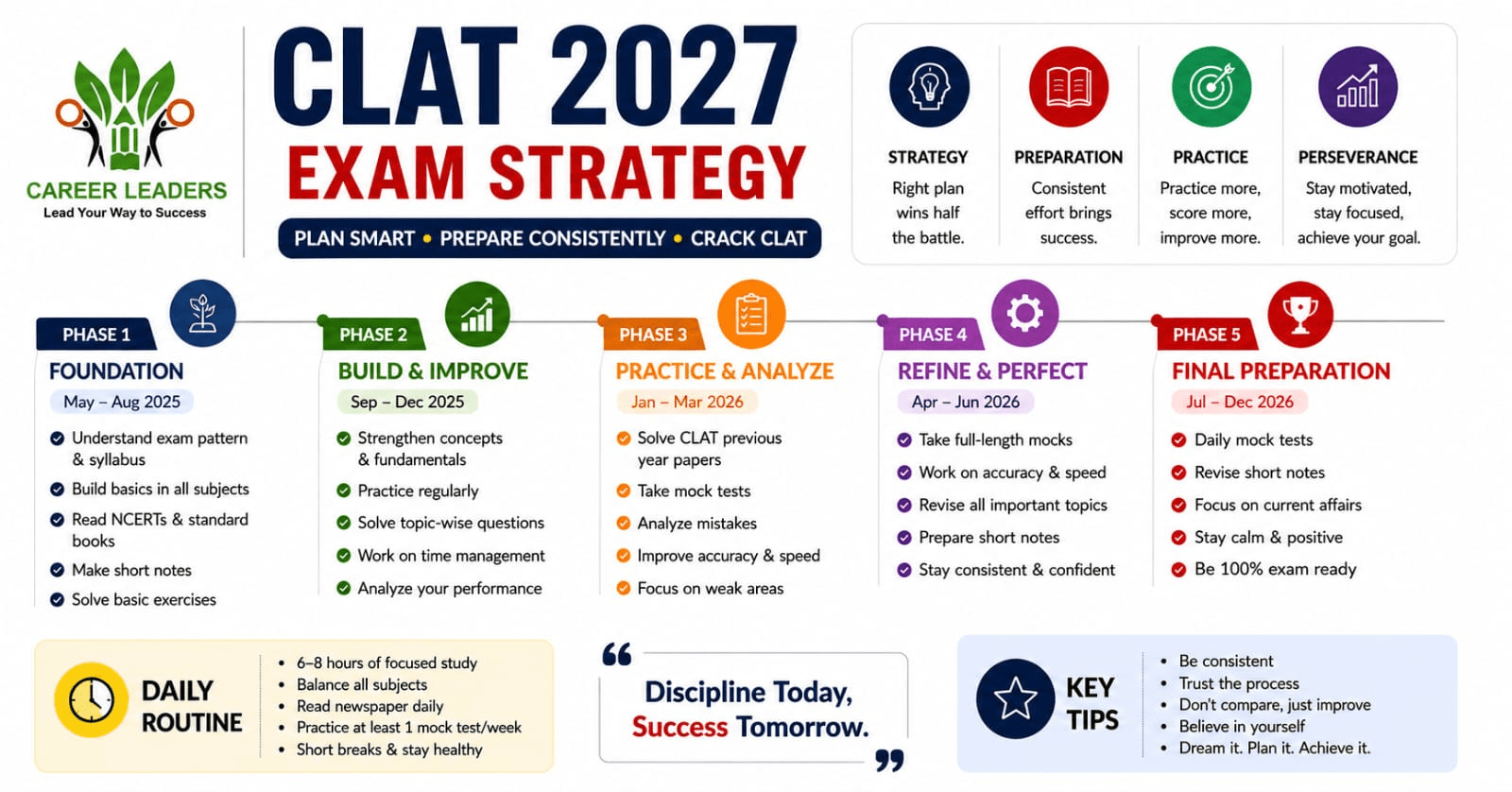
Entrance Exam Preparation Strategy for CLAT
CLAT requires students to work on multiple skills. Therefore, their Entrance Exam Preparation Strategy should include regular reading, reasoning practice, current affairs preparation, and timed question-solving.
Reading comprehension is especially important because students need to understand passages and identify relevant information quickly.
Similarly, reasoning questions require students to understand the information given and apply logical thinking.
Therefore, students should not spend their entire preparation time memorizing information. They should also practise applying concepts through questions and mock tests.
Regular analysis can help students identify the sections where they lose marks and adjust their study schedule accordingly.
Entrance Exam Preparation Strategy for IPMAT
IPMAT preparation requires a combination of quantitative and verbal skills. Consequently, an effective Entrance Exam Preparation Strategy should focus on both conceptual clarity and question-solving speed.
Students should identify frequently tested concepts and practise different types of questions from each area.
At the same time, they should track their accuracy. Solving many questions without analyzing mistakes may not produce the desired improvement.
Instead, students should maintain an error log and revise questions they previously answered incorrectly.
This makes the preparation process more focused and helps students gradually improve their performance.
Entrance Exam Study Strategy: Focus on Accuracy Before Speed
Many students believe that solving questions quickly is the most important goal. However, speed without accuracy can reduce the overall score.
A better entrance exam study strategy is to build accuracy first and then gradually increase speed.
Start by solving questions without strict time pressure. Once you become comfortable with a particular topic, introduce a time limit.
For example, you can practise a set of questions and record both your completion time and accuracy. Then, compare your performance over several weeks.
As your accuracy improves, you can gradually reduce the time taken.
Therefore, speed should be developed alongside accuracy rather than at the cost of it.
Entrance Exam Preparation Plan: Divide Your Study Time Smartly
A practical entrance exam preparation plan should divide study time according to priority rather than simply dividing it equally among subjects.
For example, if a student has three hours available each day, the schedule could include:
- 90 minutes for high-priority topics.
- 45 minutes for practice questions.
- 30 minutes for revision.
- 15 minutes for error analysis.
However, this is only an example. Students should adjust the schedule according to their exam, current preparation level, and personal strengths.
In addition, students should keep some time for revision because repeatedly reviewing important concepts can improve retention.
Entrance Exam Preparation Tips to Avoid Wasting Time
Following effective entrance exam preparation tips can help students avoid common mistakes.
First, do not spend several days trying to master one extremely difficult topic while ignoring easier scoring areas.
Second, avoid collecting too many study materials. Having multiple books, PDF, videos, and notes can create confusion.
Third, do not take mock tests simply to see the score. The real value comes from analyzing the mistakes afterward.
Finally, do not compare your daily study hours with other students. Instead, track your own progress.
Your goal should be better accuracy, stronger concepts, improved speed, and consistent revision.
How Mock Tests Help Identify Important Topics
Mock tests are useful because they show students how their preparation works under exam-like conditions.
After every mock test, divide your mistakes into categories:
- Conceptual mistakes
- Calculation mistakes
- Reading mistakes
- Time-management mistakes
- Guessing mistakes
- Careless mistakes
Then, look for patterns.
If you repeatedly make mistakes from the same topic, that topic should move higher on your priority list.
Similarly, if you spend too much time on one section, your entrance exam preparation strategy should include timed practice for that area.
Therefore, mock-test analysis can help students decide what they should study next.
Should Students Skip Low-Priority Topics?
The 80-20 rule does not mean students should completely skip everything outside the top 20%.
Instead, students should understand the difference between priority and exclusion.
High-priority topics deserve more time, practice, and revision. Medium-priority topics should receive regular preparation. Low-priority topics can receive basic coverage when time is limited.
This approach reduces the risk of leaving unexpected questions completely unprepared.
Moreover, entrance exam patterns can change. A topic that appeared less frequently in previous papers may become more important in a future exam.
Therefore, students should use the 80-20 rule intelligently rather than following it blindly.
A Simple 80-20 Entrance Exam Preparation Strategy
Students can follow these five steps:
Step 1: Understand the syllabus
Know exactly what your examination can test.
Step 2: Analyses previous papers
Look for repeated concepts, question types, and patterns.
Step 3: Identify your priority topics
Combine exam trends with your personal strengths and weaknesses.
Step 4: Practise and analyses
Take mock tests and maintain an error log.
Step 5: Revise strategically
Give more revision time to important topics while maintaining basic coverage of the remaining syllabus.
As a result, your preparation becomes more focused without becoming too narrow.
Final Thoughts on Entrance Exam Preparation Strategy
A successful Entrance Exam Preparation Strategy is not about studying everything for the same amount of time. Instead, it is about understanding what deserves more attention and using your preparation hours wisely.
The 80-20 rule can help students identify important topics, analyses their performance, improve weak areas, and prioritize high-value preparation. However, students should still maintain balanced syllabus coverage because entrance exam patterns can change.
Most importantly, preparation should be consistent. A student who studies strategically, practise regularly, analyses mistakes, and revises important concepts can make better progress than someone who simply studies for long hours without a clear plan.
Whether you are preparing for CUET, CLAT, IPMAT, BBA, Hotel Management, or another entrance examination, start by understanding your exam, identify your priorities, and build a realistic entrance exam preparation plan.
With the right entrance exam preparation tips, consistent practice, and proper guidance, students can make their preparation more focused, efficient, and confident.
Career Leaders
D-151-A, 2nd Floor, Opposite Laxmi Nagar Metro Gate No-5, Laxmi Nagar, New Delhi, Delhi 110092
Phone
+(91) 95827-15775















































































































































































































0 Comments