




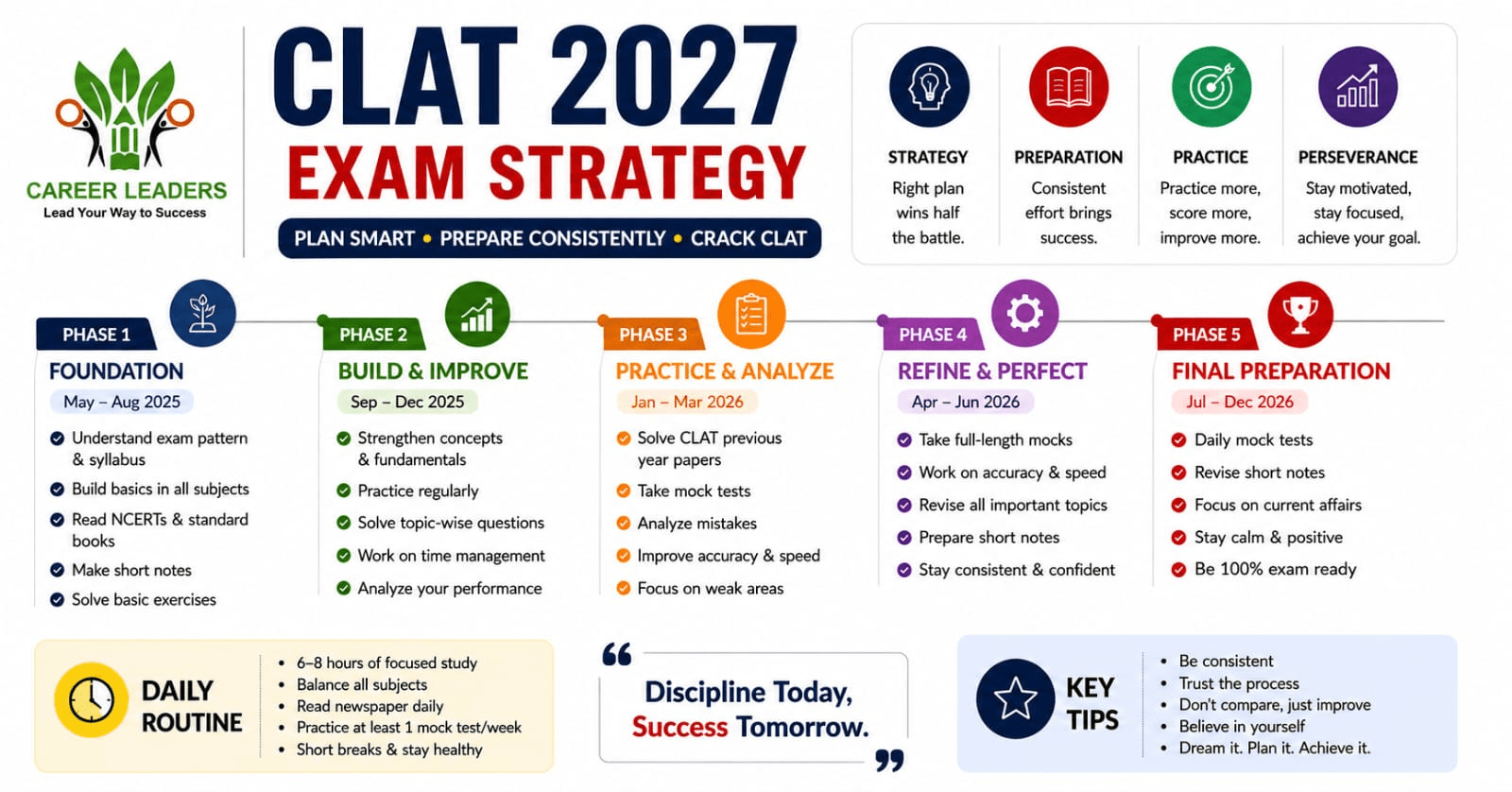
How to Improve Speed and Accuracy in Competitive Entrance Exams
Preparing for competitive exams requires more than just hard work. Students also need to improve their speed and accuracy for entrance exams to solve questions within the given time. At Career Leaders, students can learn structured preparation strategies, practice exam-level questions, and develop better test-taking skills. Whether you are preparing for CUET, IPMAT, CLAT, or another competitive entrance exam, the right approach can help you manage time effectively and avoid common mistakes. For guidance on entrance exam preparation, contact Career Leaders at +(91) 95827-15775.

Why Are Speed and Accuracy Important in Entrance Exams?
Speed and accuracy are two important factors in competitive entrance exams. Speed helps you attempt more questions within the available time. Accuracy, on the other hand, helps you select the correct answers and avoid unnecessary mistakes.
However, solving questions quickly is not enough. If you answer too many questions incorrectly, your overall score may suffer. Similarly, if you solve every question correctly but leave many unanswered, you may miss valuable marks.
Therefore, students should focus on developing both skills together. A balanced preparation strategy can help you improve your performance in CUET, IPMAT, CLAT, and other entrance examinations.
1. Understand the Exam Pattern and Syllabus
The first step to improving speed and accuracy for entrance exams is understanding the exam pattern. Before starting your preparation, learn about the sections, question types, marking scheme, and time limit.
This information helps you plan your preparation according to the actual examination requirements.
For example:
- CUET: Focus on subject knowledge, language skills, and the General Aptitude Test, where applicable to your chosen papers.
- IPMAT: Practice quantitative aptitude, verbal ability, and logical problem-solving according to the specific exam.
- CLAT: Develop reading comprehension, legal reasoning, logical reasoning, current affairs knowledge, and quantitative techniques.
Once you understand the syllabus, divide it into smaller topics. As a result, you can practice systematically instead of studying without a clear direction.
2. Practice Questions Every Day to Improve Speed
Regular practice is one of the most effective ways to improve question-solving speed. When you solve similar questions repeatedly, you become familiar with common patterns and methods.
However, do not focus only on the number of questions you complete. Instead, pay attention to the time taken and the accuracy of your answers.
Follow these simple steps:
- Select one topic for daily practice.
- Solve a set of questions without checking the answers.
- Record the time taken to complete the set.
- Check your answers and identify mistakes.
- Repeat the exercise after reviewing the concepts.
Gradually, you will become more comfortable with different question types. Consequently, you may be able to solve familiar questions in less time.
3. Focus on Accuracy Before Increasing Speed
Many students try to solve questions quickly from the beginning. However, rushing through questions can lead to calculation errors, incorrect interpretations, and missed details.
Therefore, start by developing accuracy. Make sure you understand the concept and know how to apply the correct method.
For example, if you are practicing quantitative aptitude for IPMAT, check each calculation carefully. Similarly, while preparing for CLAT, read passages and questions thoroughly before selecting an answer.
Once you can solve questions correctly and consistently, begin reducing your solving time. This gradual approach helps you build confidence without sacrificing accuracy.
4. Use Mock Tests to Improve Speed and Accuracy for Entrance Exams
Mock tests are an essential part of competitive exam preparation. They help you understand how well you perform under timed conditions.
Moreover, mock tests show whether you spend too much time on particular questions or make repeated mistakes in specific sections.
To use mock tests effectively:
- Attempt tests under the actual exam time limit.
- Avoid unnecessary breaks during the test.
- Review every incorrect and unanswered question.
- Identify sections that require more practice.
- Compare your performance across multiple tests.
After every mock test, prepare a short performance report. Record your score, accuracy, attempted questions, and time management issues.
As a result, you can make informed changes to your study plan rather than repeating the same mistakes.
5. Learn Time Management for Competitive Entrance Exams
Time management is especially important when an exam contains multiple sections. If you spend too much time on one difficult question, you may have less time for easier questions later.
Therefore, develop a clear time-management strategy before attempting a test.
First, read the instructions carefully. Next, begin with questions you can solve confidently, provided the exam format allows flexible question selection. Then, return to difficult questions if time permits.
You can also divide your practice session into timed sections. For instance, set a fixed time for a group of questions and try to complete them without rushing.
Remember that the ideal time per question depends on the exam, section, and question difficulty. Therefore, practice with the relevant exam pattern instead of following the same time limit for every question.
6. Avoid Common Mistakes During Entrance Exam Preparation
Even well-prepared students can lose marks because of avoidable errors. Fortunately, identifying these mistakes early can help improve performance.
Some common mistakes include:
- Reading questions too quickly.
- Ignoring important words such as not, except, or incorrect.
- Making calculation errors.
- Spending too long on difficult questions.
- Guessing without considering the marking scheme.
- Skipping mock test analysis.
- Studying for long hours without regular revision.
To overcome these problems, maintain a mistake notebook. Whenever you answer a question incorrectly, write down the reason and the correct method.
Furthermore, review this notebook every week. This habit helps you recognize repeated errors and avoid making them again.
7. Improve Reading Speed and Comprehension
Reading skills play an important role in several competitive entrance exams. CUET language papers and CLAT, for example, require students to understand passages and identify relevant information.
However, reading quickly without understanding the content can reduce accuracy. Therefore, focus on both reading speed and comprehension.
You can improve these skills by following a few simple habits:
- Read quality articles and editorials regularly.
- Practice passage-based questions.
- Identify the main idea of each paragraph.
- Learn unfamiliar words from context.
- Summarize what you have read in your own words.
Additionally, use a timer during reading practice. Check whether you can understand the passage and answer its questions within the target time.
With consistent practice, you can gradually become more comfortable with lengthy passages and time-bound questions.
8. Strengthen Concepts and Learn Shortcuts Carefully
Shortcuts can save time, particularly in quantitative aptitude and logical reasoning. However, they work best when you understand the underlying concepts.
First, learn the standard method for solving a question. Then, explore alternative techniques that are appropriate for that question type.
For example, mental calculations, percentage-fraction conversions, approximation, and elimination techniques may help you solve certain questions faster.
Nevertheless, do not use a shortcut simply because it appears quicker. Check whether it is reliable and suitable for the question.
Practice the method several times before using it in a mock test. This way, you can improve efficiency while maintaining accuracy.
9. Create a Daily Routine for Entrance Exam Preparation
A consistent routine helps students balance school studies with entrance exam preparation. Instead of studying randomly, divide your available time into manageable sessions.
Here is a sample routine that you can adjust according to your school timings and exam requirements:
| Activity | Suggested Time |
|---|
| Concept revision | 30 minutes |
| Topic-wise question practice | 45 minutes |
| Reading comprehension or verbal practice | 30 minutes |
| Quantitative or logical reasoning practice | 30 minutes |
| Mistake analysis and revision | 15 minutes |
This schedule provides approximately 2.5 hours of focused study. However, your daily study time may vary depending on your school workload and preparation level.
On weekends, attempt a sectional test or a full-length mock test when appropriate. Afterward, analyses your performance and plan the following week’s practice.
Most importantly, maintain consistency. A realistic routine followed regularly is more useful than an overly demanding timetable that is difficult to sustain.
10. Track Your Progress and Improve Weak Areas
You cannot improve what you do not measure. Therefore, keep a record of your practice sessions and mock test performance.
Track these important factors:
- Total questions attempted.
- Correct and incorrect answers.
- Time taken to complete each section.
- Accuracy percentage.
- Topics that need additional revision.
You can calculate accuracy using this formula:
Accuracy (%) = (Correct Answers ÷ Total Questions Attempted) × 100
For example, if you attempt 80 questions and answer 68 correctly, your accuracy is 85%.
However, accuracy alone does not show your complete performance. You should also consider negative marking, unanswered questions, question difficulty, and time management.
Review your results every week. Then, focus your next practice sessions on the areas where you need the most improvement.
How Career Leaders Can Help You Prepare for Competitive Entrance Exams
Preparing for entrance exams can feel challenging when you have to manage several subjects, school assignments, and mock tests. However, a structured preparation plan can make the process more manageable.
Career Leaders supports students preparing for entrance examinations through exam-focused learning and preparation guidance. Students can work on concept clarity, question practice, revision, and time management according to their examination goals.
Whether you are preparing for CUET, IPMAT, CLAT, or other entrance exams offered through relevant preparation programmes, make sure your study plan matches the syllabus and requirements of your chosen examination.
For course details and preparation guidance, contact Career Leaders at +(91) 95827-15775.
Conclusion
Improving speed and accuracy for entrance exams requires regular practice, clear concepts, effective time management, and consistent performance analysis. Simply solving more questions will not always improve your score. Instead, focus on understanding your mistakes and developing a reliable method for each question type.
Start with topic-wise practice, gradually introduce timed tests, and analyses your performance after every mock test. In addition, maintain a realistic study routine and revise your weak areas regularly.
With patience and a structured approach, you can develop better question-solving habits and prepare more confidently for CUET, IPMAT, CLAT, and other competitive entrance exams.
Take the next step in your preparation with Career Leaders. Call +(91) 95827-15775 to enquire about entrance exam preparation programmes.
Career Leaders
D-151-A, 2nd Floor, Opposite Laxmi Nagar Metro Gate No-5, Laxmi Nagar, New Delhi, Delhi 110092
Phone
+(91) 95827-15775

















































































































































































































0 Comments