





Introduction
The Common Law Admission Test (CLAT) is a national-level entrance exam for students who want to study law at top National Law Universities (NLUs) in India. Every year, thousands of Class 11 and 12 students appear for CLAT, which makes the competition tough. Because of this, understanding the Exam pattern and syllabus becomes the first and most important step in preparation. When students clearly know what is asked in the exam, they can plan their study in the right direction. This clarity also helps parents and students decide whether self-study is enough or if CLAT coaching in Delhi is required for structured guidance. Moreover, knowing the pattern helps avoid random preparation and saves time. In this blog, the CLAT exam pattern and syllabus are explained in simple language so that beginners can understand easily and start their preparation with confidence.
CLAT Exam Overview – What Every Aspirant Must Know
CLAT stands for Common Law Admission Test. It is conducted for admission to undergraduate (UG) and postgraduate (PG) law courses.
For UG CLAT, eligibility usually includes passing Class 12 or appearing students. The exam is conducted in offline mode (pen and paper). The duration of the exam is 2 hours.
Each question carries one mark, and there is negative marking of 0.25 marks for every wrong answer. The difficulty level of CLAT is considered moderate to high because it focuses more on comprehension and reasoning rather than rote learning. Therefore, concept clarity is essential for scoring well.
CLAT Exam Pattern Explained in Simple Language
The CLAT UG exam is divided into five sections. All questions are passage-based, which means students must read and understand before answering.
- English Language – Tests reading comprehension and vocabulary
- Current Affairs & General Knowledge – Focuses on recent events and static GK
- Legal Reasoning – Checks legal awareness and logical application
- Logical Reasoning – Includes arguments, assumptions, and conclusions
- Quantitative Techniques – Basic maths based on data interpretation
Each section has a specific weightage, with Legal Reasoning and Current Affairs carrying higher importance. Because of negative marking, time management becomes crucial. Students must learn when to attempt and when to skip questions.
CLAT Syllabus – Subject-Wise Breakdown
English Language
This section is based on passages. Questions test comprehension, grammar, vocabulary, and inference skills. Regular reading of newspapers and articles helps a lot.
Current Affairs & General Knowledge
Questions come from national and international events. Static GK like history and polity is also important. Daily news reading is necessary.
Legal Reasoning
Legal passages are given, followed by questions. Students are not expected to know deep law concepts. However, understanding basic legal principles is helpful.
Logical Reasoning
This section tests analytical thinking. Questions are based on arguments, statements, and logical conclusions.
Quantitative Techniques
Basic maths from Class 10 level is tested. Questions involve graphs, tables, and simple calculations.
Why Understanding CLAT Pattern Is Important for Coaching Selection
Understanding the exam pattern helps students choose the right CLAT coaching in Delhi. When the syllabus is clear, coaching institutes can align their teaching with exam demands. Syllabus-based preparation ensures that no important topic is missed. Moreover, structured coaching focuses on mock tests and performance analysis, which is difficult to manage alone. Random study without understanding the pattern often leads to confusion. Therefore, coaching provides a disciplined approach, proper guidance, and regular assessment.
Online vs Offline CLAT Coaching – What Suits You Best?
Online CLAT coaching is useful for students who want flexibility and access to recorded lectures. It saves travel time and allows learning from home.
Offline coaching in Delhi is suitable for students who prefer classroom learning, face-to-face interaction, and peer competition. Many students also opt for a hybrid model that combines online resources with offline mentoring. The right choice depends on learning style, location, and discipline level.
How Top CLAT Institutes in Delhi Prepare Students
A Top CLAT institute Delhi focuses on experienced faculty, updated study material, and regular mock tests. Faculty members simplify complex concepts and guide students step by step. Mock test systems help students analyze mistakes and improve scores. Personal mentorship and doubt-solving sessions also play a key role. Institutes like Career Leaders are known for structured teaching and exam-focused preparation, which helps students stay on track.
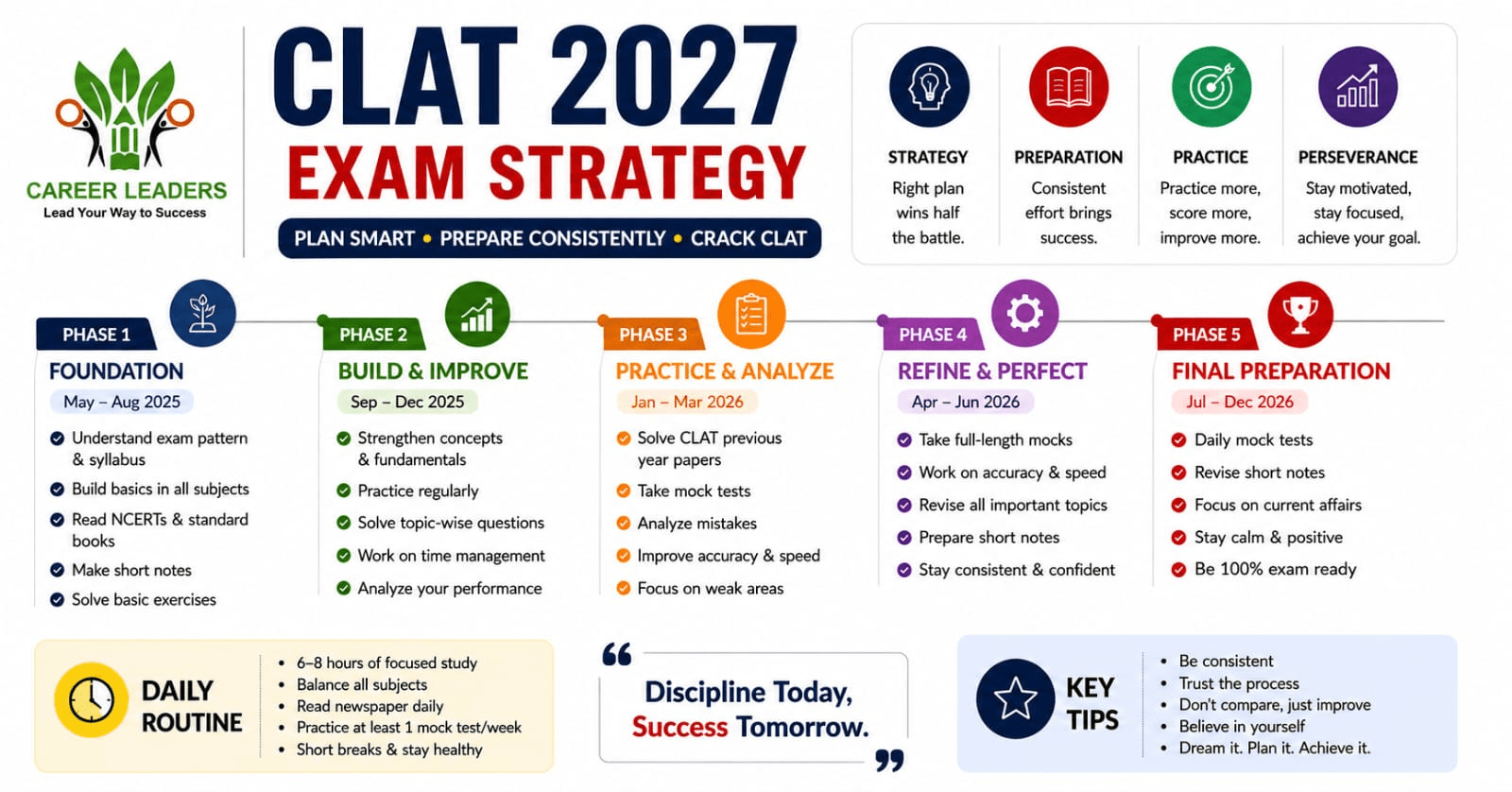
Tips to Prepare CLAT Effectively Using Exam Pattern
- Allocate time based on section weightage
- Develop a daily reading habit for English and Current Affairs
- Attempt mock tests weekly, then increase frequency
- Revise mistakes regularly
- Avoid guessing answers blindly due to negative marking
Consistency and smart planning are more important than studying long hours.
FAQs
What is the CLAT exam pattern?
CLAT has five sections with passage-based questions and negative marking.
Has CLAT syllabus changed recently?
The core syllabus remains the same, but question style focuses more on comprehension.
Is coaching necessary for CLAT preparation?
Coaching helps with structure, mocks, and guidance, especially for beginners.
Is online CLAT coaching effective?
Yes, if the student is disciplined and follows a proper schedule.
When should students start CLAT preparation?
Ideally, students should start from Class 11 for better concept clarity.
Final Words
Preparing for CLAT becomes easier when students clearly understand the exam pattern and syllabus. Before joining any coaching, it is advisable to seek proper guidance and counselling. A clear strategy always leads to better results and confident preparation.














































































































































































































0 Comments